
Balanced Approach to Risk
2026
A diversified investment strategy, balancing traditional and alternative markets. Its allocation reflects a balanced approach—growth-focused but diversified across traditional equities, commodities, currencies, and digital assets. It’s designed to capture upside while managing downside risk through non-correlated assets.
Investment Allocation
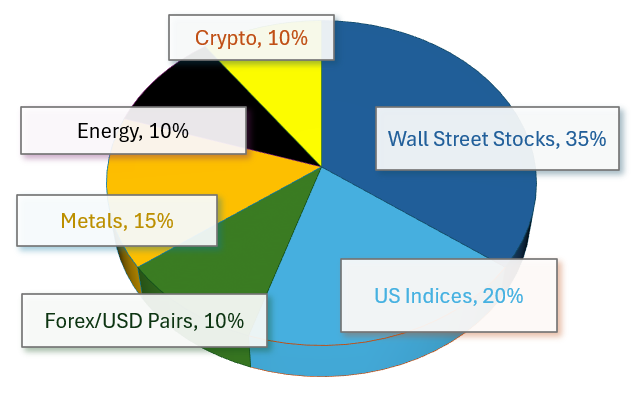
We aim to achieve balanced growth while managing risk through diversified exposure across multiple asset classes. By allocating more capital to Wall Street stocks and US indices, we target steady appreciation from established markets. The strategy seeks to capture opportunities across traditional and emerging markets, aiming for long-term capital appreciation with a resilient portfolio structure.
-
Wall Street Stocks 35% – Core growth engine. Offers exposure to individual companies with potential for price to grow.
-
US Indices 20% – Helps smooth volatility from individual stocks.
-
Forex/USD Pairs 10% – Provides global diversification and hedges against currency risk.
-
Metals / Gold 15% – Inflation hedge and safe-haven asset. Balances risk during economic uncertainty.
-
Energy / Crude Oil 10% – Cyclical sector with potential upside during supply shocks or geopolitical tensions.
-
Crypto 10% – High-risk, high-reward; Offers exposure to emerging digital assets and blockchain innovation

Investment Considerations
This strategy reflects a balanced, multi-asset approach designed to capture growth across traditional and alternative markets while managing risk through diversification. With over half the portfolio allocated to Wall Street stocks and U.S. indices, it leans into equity-driven growth, supported by global macro trends and corporate earnings. The inclusion of Forex and metals introduces defensive and inflation-hedging elements, while energy and crypto provide cyclical and speculative upside. The strategy is well-suited for investors seeking long-term capital appreciation with exposure to both stability and innovation.
♦ Equity-Driven Core -Wall Street Stocks and U.S. Indices: This is the engine of the portfolio. Wall Street stocks allow for targeted exposure to high-growth sectors or blue-chip leaders, while U.S. indices offer broad market participation and reduce single-stock risk. Together, they provide a strong foundation for capital appreciation, especially in stable or expanding economic environments.
♦ Currency Diversification – Forex/USD Pairs: This allocation introduces global exposure and acts as a hedge against domestic currency weakness.
♦ Inflation Hedge – Metals: Gold and silver serve as traditional safe havens, especially during inflationary periods or market stress. This allocation helps preserve capital when equities falter.
♦ Cyclical Upside – Energy: A small, strategic allocation, energy assets like oil and gas can outperform during inflationary spikes, supply disruptions, or geopolitical tensions. However, they are sensitive to demand cycles and regulatory shifts.
♦ Speculative Growth – Crypto: Crypto offers asymmetric upside and exposure to blockchain innovation, but it comes with extreme volatility and regulatory uncertainty. There is a strong belief in the long-term viability of digital assets.
Strategy Asset Allocation- February 2026
In 2026, our allocation emphasizes assets that are currently underperforming but fundamentally positioned for a rebound as U.S. conditions evolve through 2026. With inflation gradually cooling and the Federal Reserve expected to ease policy only cautiously, sectors and instruments that lagged during the high‑rate environment, such as certain Wall Street value stocks, gold, crude oil, and select crypto assets, stand to benefit from renewed liquidity and rotation. The U.S. political climate, marked by uncertainty around fiscal priorities, trade policy, and regulatory shifts, creates pockets of mispricing that favor contrarian positioning. Meanwhile, ongoing geopolitical tensions and war‑related disruptions continue to pressure supply chains and energy markets, making discounted commodities and safe‑haven metals attractive recovery plays. A stronger‑for‑longer U.S. dollar also shapes the FX component, where undervalued USD pairs offer tactical opportunities as global economies diverge. Overall, the portfolio leans into assets that have underperformed relative to their intrinsic or cyclical potential, aiming to capture upside as macro conditions normalize.
– Underlying Asset: Wall Street Stocks –
In early 2025, Wall Street experienced a sharp and unexpected drawdown, particularly in April, triggered by sweeping trade tariffs announced by President Trump on what was dubbed “Liberation Day.” The move sparked fears of a global recession, leading to panic selling across major indices and the steepest market decline since 2020. Investor sentiment shifted dramatically, with retail investors exiting positions and forecasts turning bearish. However, the market found its footing by mid-April, rebounding on the back of strong earnings and renewed optimism in AI and tech sectors, ultimately recovering much of its losses by October. As the year closes, Wall Street remains cautiously optimistic, with investors rotating into industrials, energy, and defense alongside continued enthusiasm for AI and infrastructure plays.
Visa Inc.
Initial assessment date: 06.02.2026
Visa, Inc engages in the provision of digital payment services. It also facilitates global commerce through the transfer of value and information among global network of consumers, merchants, financial institutions, businesses, strategic partners, and government entities.
Analysts broadly expect Visa to continue delivering strong fundamental performance in 2026, supported by global digital‑payments growth, AI‑driven efficiency gains, and expansion into stablecoin and digital‑currency infrastructure.
While political scrutiny and regulatory pressure may slow parts of its growth, forecasts still point to solid earnings expansion and long‑term upside.
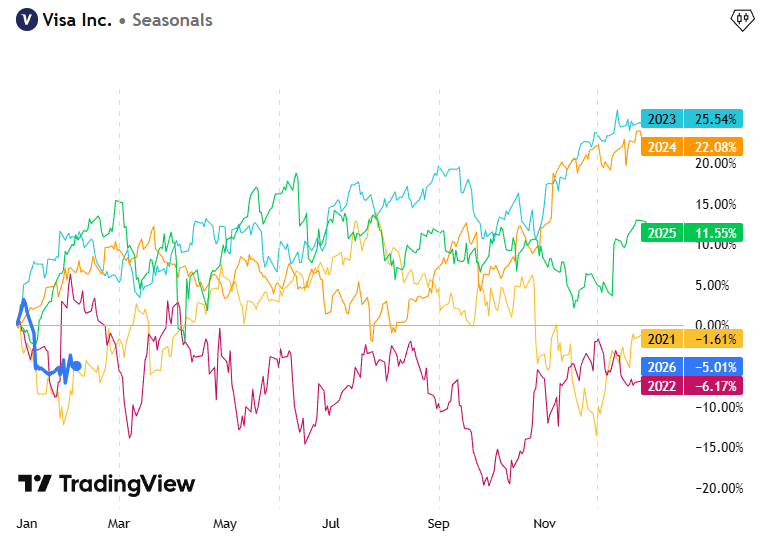
V (VISA) Seasonals – Performance per Year
V (VISA) Analysis & Forecast
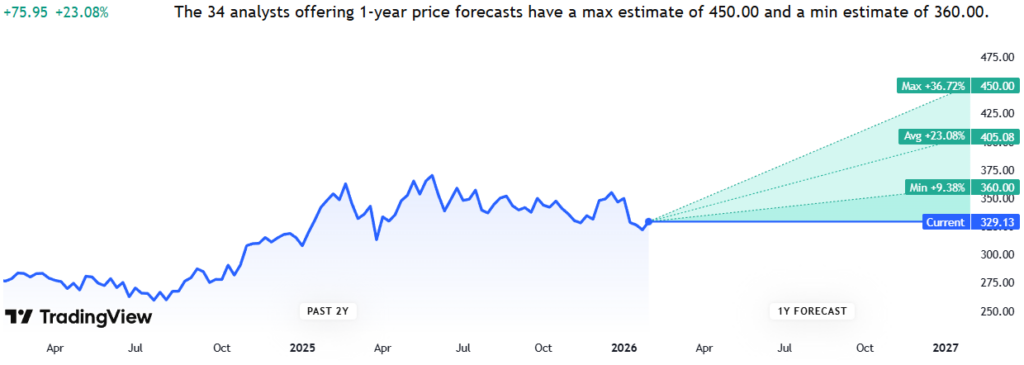
♦ Price: 329.13 USD
♦ Forecast Value: 1 year Average is 405 USD Upside: 23% in 2026
♦ Seasonals: Based on 4Year Average, Upside: 13.25%
♦ Asset Type: Share ♦ Sector: Finance
V (VISA) Current Performance
Roku, Inc. / ROKU
Initial assessment date: 06.02.2025
Roku is a leading U.S. streaming‑platform company best known for its operating system, which powers millions of smart TVs and streaming devices. The company generates most of its revenue from its high‑margin platform business, including advertising, content distribution, and subscription partnerships.
With a large and expanding user base, Roku plays a central role in the shift from traditional TV to digital streaming, positioning itself as a key gateway between viewers, content creators, and advertisers.
Roku presents an appealing opportunity for 2026 because the company is emerging from a deep multi‑year drawdown just as key fundamentals begin to improve.
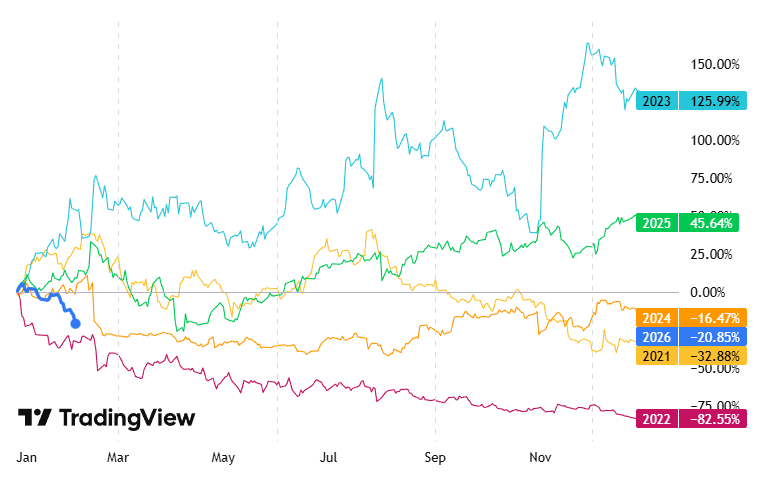
ROKU Seasonals – Performance per Year
ROKU Analysis & Forecast
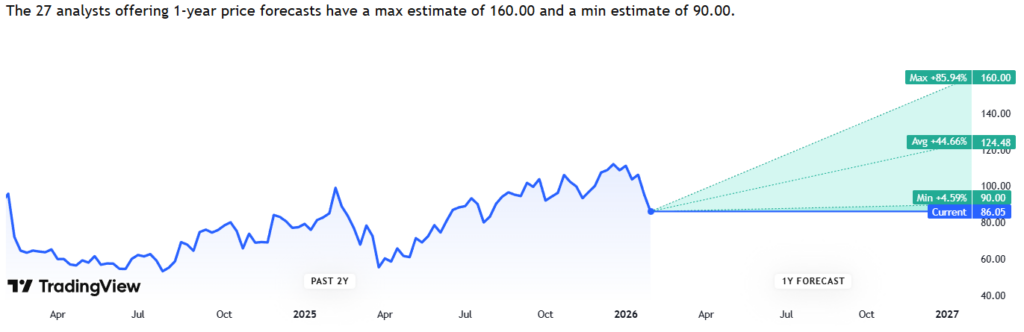
♦ Price: 86.05 USD
♦ Forecast Value: 1 year Average is 124.48 USD Upside: 44.6% in 2026
♦ Seasonals: Based on 4Year Average 152.77% Upside: 18.15%
♦ Asset Type: Share ♦ Sector: Technology Services
ROKU Current Performance
Coinbase Global, Inc. – 3 / COIN
Initial assessment date: 06.02.2025
Coinbase is positioning itself as a major long‑term infrastructure player in crypto, and 2026 looks like a pivotal year driven by regulation, tokenization, and institutional adoption.
The company’s latest outlook highlights a shift from speculative trading toward real-world utility, with growth expected in stablecoins, ETFs, and tokenized assets.
Coinbase is evolving from a simple crypto exchange into a broader financial infrastructure provider. Its 2026 outlook emphasizes tokenization of real‑world assets, stablecoin expansion, and clearer global regulation as the next major growth engines.
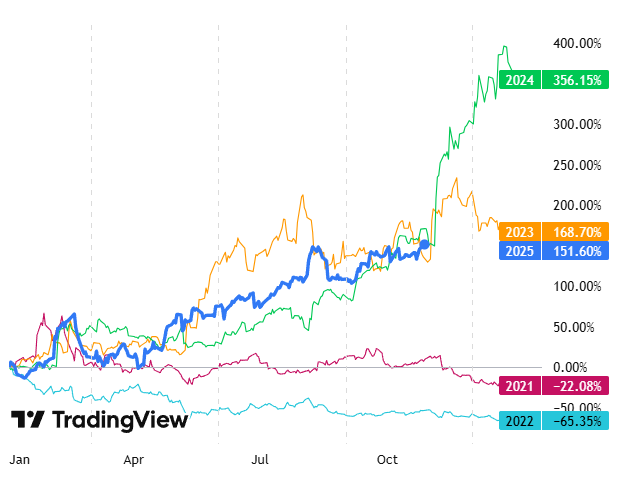
COIN Seasonals – Performance per Year
COIN Analysis & Forecast
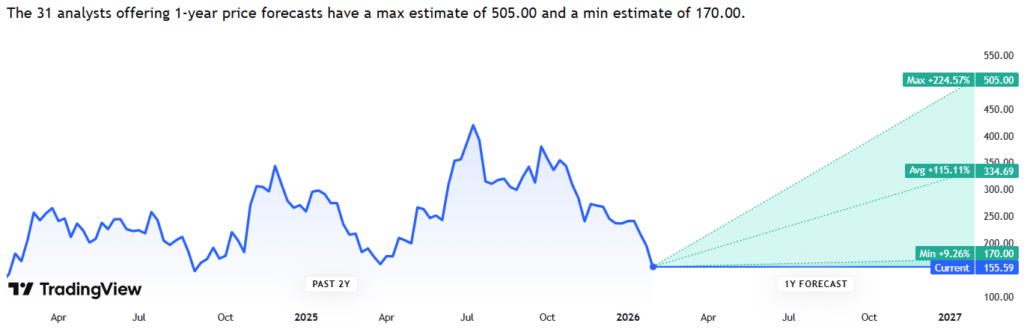
♦ Price: 154.70 USD
♦ Forecast Value: 1 year Average is 334.69 USD Upside: 116% in 2026
♦ Seasonals: Based on 4Year Average, Upside: 94%
♦ Asset Type: Share ♦ Sector: Finance
COIN Current Performance
Robinhood Markets, Inc. / HOOD
Initial assessment date: 06.02.2025
Robinhood Markets, Inc is a financial services platform, which engages in the provision of retail brokerage and offers trading in U.S. listed stocks and Exchange Traded Funds, related options, and cryptocurrency trading, as well as cash management, which includes debit cards services.
It remains a major fintech platform known for commission‑free trading, fractional shares, and easy retail access to markets. Its rapid growth has pushed the company into the spotlight, with revenue doubling in the past year.
Some forecasts show potential for significant price appreciation later in 2026, with certain models projecting strong gains in the second half of the year.
HOOD Seasonals – Performance per Year
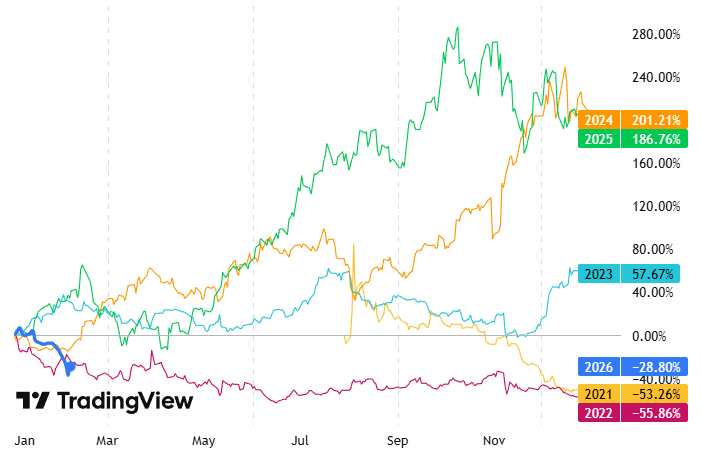
HOOD Analysis & Forecast
♦ Price: 80.50 USD
♦ Forecast Value: 1 year Average is 148.38 USD Upside: 84.3% in 2026
♦ Seasonals: Based on 4Year Average, Upside: 97.4%
♦ Asset Type: Share ♦ Sector: Finance
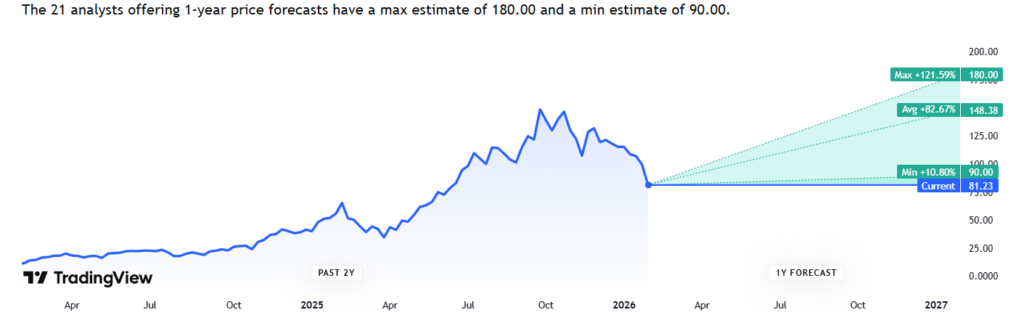
HOOD Current Performance
Palantir Technologies Inc. / PLTR
Initial assessment date: 06.02.2026
Palantir Technologies, Inc. engages in the business of building and deploying software platforms that serve as the central operating systems for its customers. A standout performer in data analytics and defense tech. Its government contracts and AI capabilities have made it one of the top S&P 500 gainers.
It enters 2026 with explosive revenue growth, surging commercial adoption, and record profitability, making it one of the strongest AI‑driven enterprise software stories in the market.
Palantir issued a bullish 2026 revenue outlook, projecting 61% year‑over‑year growth to roughly $7.2 billion. This far exceeds Wall Street expectations and signals accelerating demand for its AI platforms.
PLTR Seasonals – Performance per Year
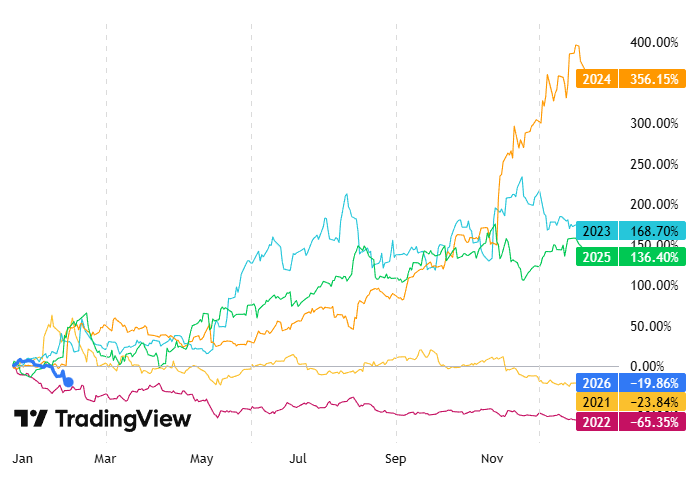
PLTR Analysis & Forecast
♦ Price: 133.71 USD
♦ Forecast Value: 1 year Average is 192.77 USD Upside: 44.17% in 2026
♦ Seasonals: Based on 4Year Average, Upside: 148.9%
♦ Asset Type: Share ♦ Sector: Technology Services
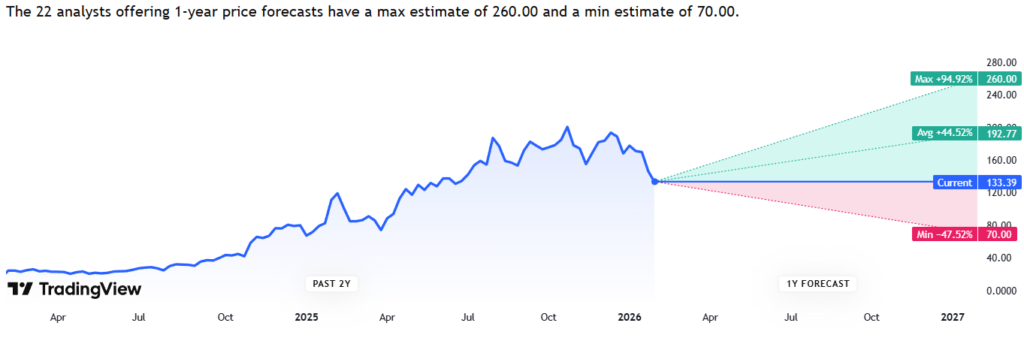
PLTR Current Performance
– Underlying Asset: US Stock Index – USTEC
Analysts generally see 2026 as a continuation of the long‑term tech expansion, driven by AI adoption, cloud infrastructure growth, semiconductor demand, and strong balance sheets across mega‑cap tech. Most forecasts for the NASDAQ‑100 place it higher in 2026 than in 2025, with ranges clustering around 24,000–28,000, and some models projecting 29,000+ by year‑end. Because USTEC mirrors the performance of major U.S. tech names through its ESG‑filtered index, the ETF is expected to follow this upward trajectory. Forecasting models for USTEC itself point to a moderate but steady rise, with the ETF gaining roughly 15–20% over the year, assuming no major macro shocks. The drivers are consistent: strong earnings from AI‑heavy companies, easing interest rates that support growth‑stock valuations, and continued capital inflows into U.S. tech as a structural theme.
US Tech 100 Index (USTEC) / NAS100
Initial assessment date: 06.02.2026
The US Tech 100 (USTEC) is the CFD representation of the Nasdaq‑100, an index that tracks 100 of the largest non‑financial companies listed on the Nasdaq exchange.
Analysts broadly expect the US100 (Nasdaq‑100) to remain bullish in 2026, supported by AI-driven earnings growth, monetary easing, and strong U.S. economic performance.
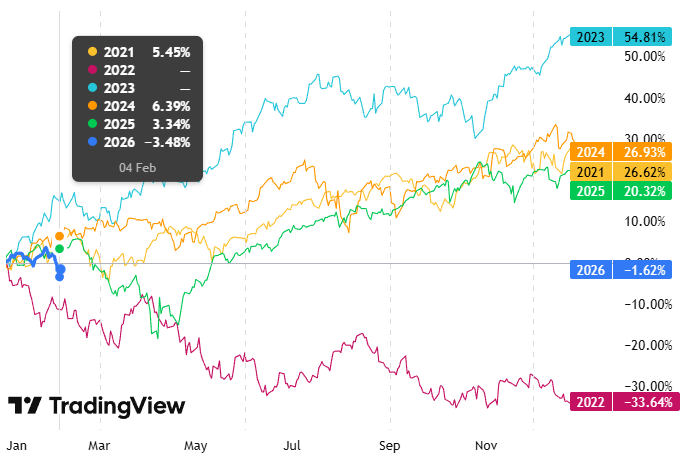
USTEC/NAS100 Seasonals – Performance per Year
USTEC/NAS100 Analysis & Forecast
♦ Price: 24,865 USD
♦ Forecast Value: 26,000 USD Upside: 4.5%
♦ Seasonals: Based on 4Year Average, Upside: 17%
♦ Asset Type: Stock Index.
♦ Sector: Tech Sector. Also includes exposure to several related sectors.
USTEC/NAS100 Current Performance
– Underlying Asset: Forex Pairs – USDJPY
Analysts broadly expect USD/JPY to stay elevated through 2026, driven mainly by the wide and persistent interest‑rate gap between the U.S. and Japan. Most major banks see the Federal Reserve keeping rates higher for longer, while the Bank of Japan moves very slowly with normalization, which keeps the yen structurally weak. Add in Japan’s long‑standing issues—low inflation momentum, aging demographics, and limited productivity growth—and the consensus view is that USD/JPY remains firmly biased upward, with many forecasts placing it in the 155–165 range during 2026, assuming no major shocks.
USDJPY
Initial assessment date: 06.02.2026
Analysts generally expect USD strength to dominate into 2026, making the most supported trades long USD/JPY (because Japan’s tightening remains slow and yield differentials stay wide) and short EUR/USD (as Eurozone growth lags and the ECB is likely to cut earlier than the Fed), while a more contrarian but still credible 2026 play is long AUD/USD, supported by commodities and a relatively hawkish RBA.
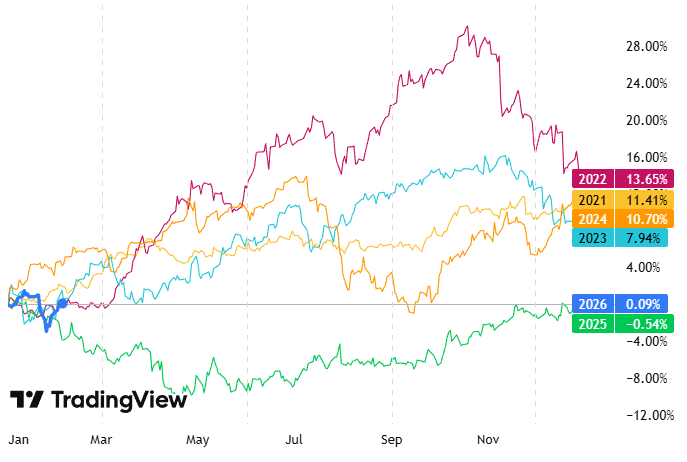
USDJPY Seasonals – Performance per Year
USDJPY Analysis & Forecast
♦ Price: 156.95 USD
♦ Forecast Value: 165 USD Upside: 5% in 2026
♦ Seasonals: Based on 4Year Average, Upside: 7.9%
♦ Asset Type: Forex Pair.
♦ Sector: Currency Market.
USDJPY Current Performance
– Underlying Asset: XAUUSD (Gold) –
Gold is seen as operating in a new structural price regime, where the floor is much higher than in previous cycles. Most forecasts now frame 2026 in a $4,500–$5,300 range, driven by declining real yields, ongoing de‑dollarization flows from emerging‑market central banks, and persistent geopolitical risk. Instead of asking “Will Gold break out?”, analysts now focus on how long Gold can remain above $4,500, with the consensus that the macro environment continues to support elevated prices throughout 2026.
Gold / XAUUSD
Initial assessment date: 06.02.2026
The forces that pushed XAUUSD to historic levels like global rate‑cut cycles, geopolitical fragmentation, persistent central‑bank accumulation, and declining real yields are expected to remain in place throughout 2026. Analysts expect Gold will be kept elevated, stable, and strategically important in global portfolios.
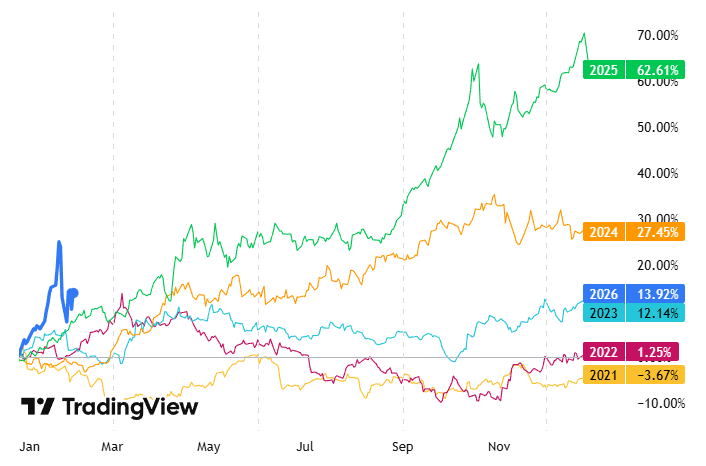
XAUUSD Seasonals – Performance per Year
XAUUSD Analysis & Forecast
♦ Price: 4,941 USD
♦ Forecast Value: 5,300 USD Upside: 7% in 2026
♦ Seasonals: Based on 4Year Average, Upside: 25.86%
♦ Asset Type: Commodity.
♦ Sector: Consumer and Industrial sectors.
XAUUSD Current Performance
– Underlying Asset: Crypto –
2025 has been a transformative year for digital assets, marked by strong growth, institutional adoption, and technological innovation.The market has shifted away from hype-driven cycles to more sustainable growth. Bitcoin had a remarkable year in 2025, marked by strong price growth, institutional adoption, and favorable regulatory developments.
BTC/USD – Bitcoin US Dollar
Initial assessment date: 22.10.2025
Bitcoin Bitcoin had a strong year, driven by institutional adoption, regulatory clarity, and macroeconomic shifts. Analysts forecast potential highs of $200,000 by the end of 2025 if Bitcoin sustains momentum above key thresholds.
Major firms increased BTC holdings, boosting demand. U.S. policies became more favorable, encouraging institutional participation
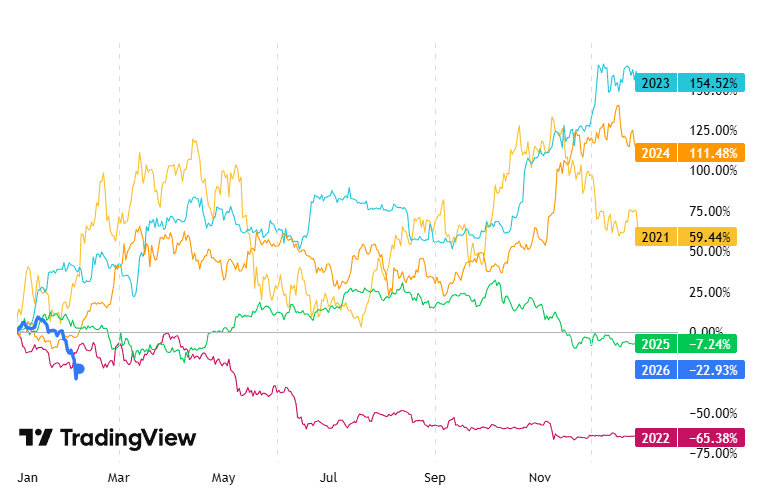
BTC/USD Seasonals – Performance per Year
BTC/USD Analysis & Forecast
♦ Price: 108.180 USD
♦ Forecast Value: 200,00 USD Upside: 84% EoY 2025
♦ Seasonals: Based on 4Year Average 54.41% Upside: 39.78%
♦ Asset Type: Cryptocurrency.
♦ Sector: Cryptocurrency sector, financial technology (fintech).
BTC/USD Current Performance
– Underlying Asset: Commodities – WTI Crude Oil
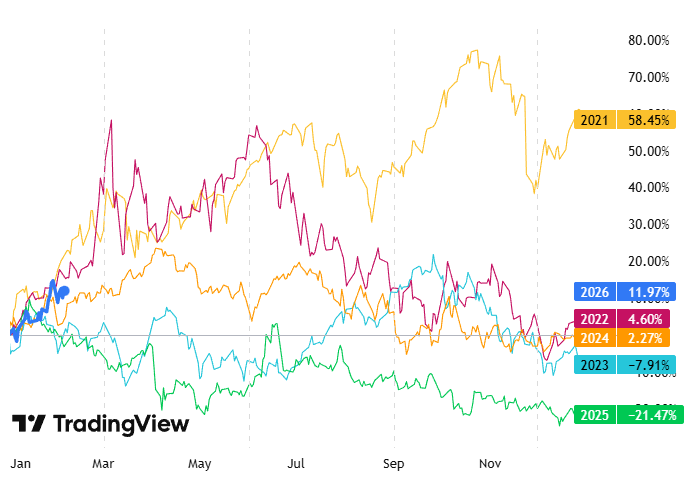
WTI crude oil prices in 2026 are projected to hover in the low‑to‑mid $50s per barrel, with most forecasts pointing to a bearish, oversupplied market rather than a strong investment case. Current analyses suggest that 2026 may be a challenging year for oil bulls, with multiple institutions expecting downward pressure driven by surplus production and softening demand.
US Crude Oil / WTI
Initial assessment date: 06.02.2026
While the market remains highly sensitive to geopolitical disruptions that could trigger short‑term volatility, the structural outlook for 2026 is shaped by steady OPEC+ supply, rising non‑OPEC production, and softer demand growth, factors that collectively cap the potential for sustained price appreciation.
WTI Seasonals – Performance per Year
WTI Analysis & Forecast
♦ Price: 64.32 USD
♦ Forecast Value: max 66 USD, Upside: 2% in 2026
♦ Seasonals: Based on 4Year Average, Upside: -5.38%
♦ Asset Type: Energy/commodity.
♦ Sector: Energy sector.
WTI Current Performance
Calculated Risk and Performance
In this section, we aim to estimate the potential risk of loss and potential performance based on historical data and current market conditions. The strategy involves algorithmic and active approach that could result in having better performance than just a passive approach. The timing of each investment is crucial for assessing both potential losses and expected returns on an annual basis.
RD: This is Relative Drawdown which is a volaitlity metric. During the period 2021-2025 we see that maximum relative dawdown for metals is close to 30%. We take this factor into consideration when assessing risk of loss. 2022 was a year full of uncertainty and risk-assets (including stocks and metals) have experienced huge drawdowns.
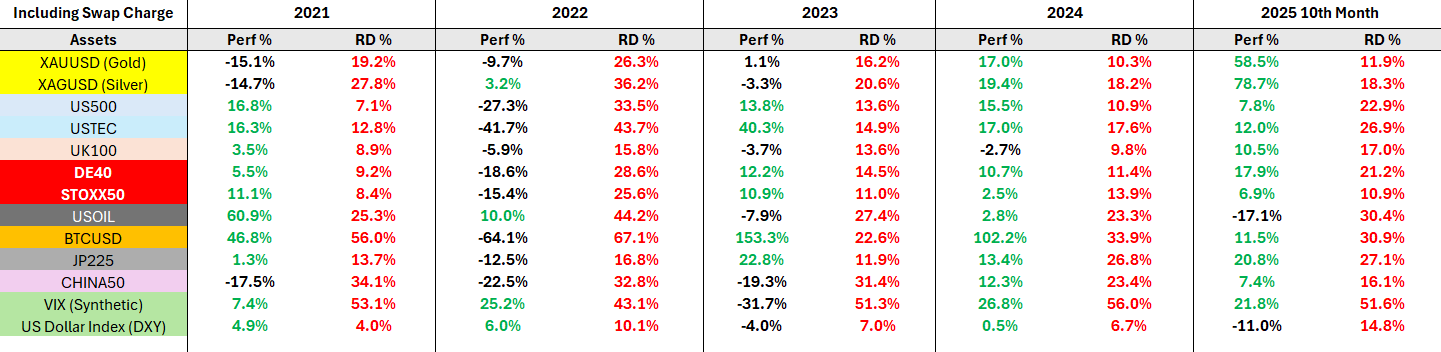
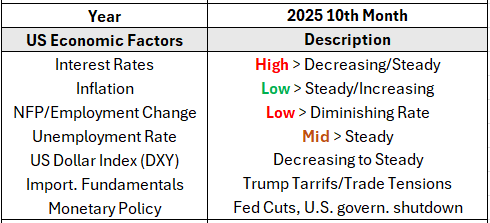
♦ In 2020, inflation decreased following the onset of COVID-19, while unemployment rose sharply. In response, interest rates were lowered to stimulate the economy. By 2021, the unemployment rate began to decline, but inflation increased due to a surge in demand for goods and services. This heightened demand also drove up the need for oil in business operations, leading to higher oil prices. The value of the US dollar weakened, making it relatively cheaper in 2021. Metals were less favored as investments; instead, people turned to stocks and riskier assets such as cryptocurrencies. This shift eventually contributed to rising inflation.
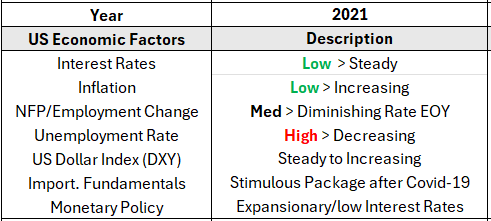
♦ In 2022, the unemployment rate fell to low levels, but inflation rose significantly. To combat inflation, the Federal Reserve began raising interest rates aggressively. As a result, the US dollar appreciated, making foreign investment in US stocks less attractive. Growing economic uncertainty led to reduced confidence in cryptocurrencies and even metals. However, metals were still favored by some investors as a hedge against inflation. The onset of war further drove up crude oil prices during the early stages.
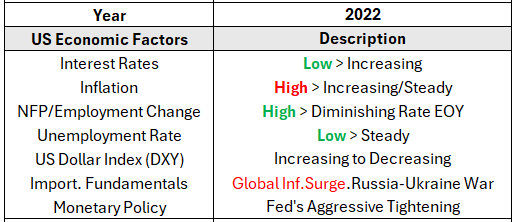
♦ In 2023, interest rates remained high, and inflation began to decline as anticipated. Labor market data indicated a strong U.S. economy that was not severely impacted by elevated interest rates, with overall expectations remaining positive. The unemployment rate stayed low, and the U.S. dollar weakened slightly. After a challenging 2022, U.S. stocks made a remarkable recovery, while cryptocurrencies benefited from the renewed risk-on sentiment. Oil prices held steady, resisting a decline, particularly due to ongoing geopolitical tensions and conflicts.
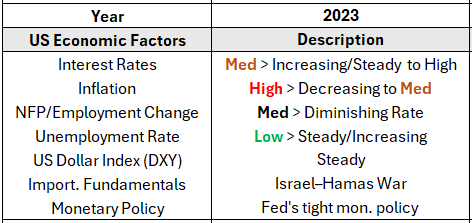
♦ In 2024, as inflation declined, interest rate cuts were initiated to address emerging labor-related risks. Unemployment began to rise slightly, while the U.S. dollar remained stable without becoming more expensive. The U.S. stock market delivered a strong performance, fueled by falling inflation, increased investor confidence, and easing financial conditions. Enthusiasm around artificial intelligence played a major role in driving investments in both stocks and cryptocurrencies, reflecting a renewed risk-on sentiment. Crude oil prices rose but eventually stabilized.
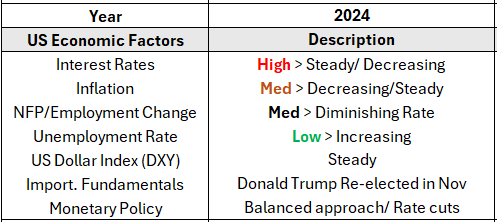
♦ In 2025, interest rates in the U.S. remained high, while other central banks pursued aggressive rate cuts. Tariffs introduced by President Trump created significant uncertainty, causing stock markets to decline sharply until April. Although inflation was substantially reduced, labor market data began to reveal notable negative trends throughout the year. A government shutdown further fueled investor anxiety, triggering a risk-off sentiment. As a result, investors sought refuge in metals. Both stocks and cryptocurrencies were negatively impacted by the shutdown. Crude oil prices continued to decline.