

A structured approach to Investment Strategy
(1) Define Financial Goals (2) Assess Risk Tolerance
(3) Determine Time Horizon (4) Select Investment Style
(5) Asset Allocation & Diversification (6) Continuous Monitoring & Rebalancing
TI Based Approach
TI stands for Traditional Investment. Asset positions are consistently held in a long/buy direction. The methods below are based on the simplest form of the cost-averaging approach that involves buying more quantity when prices are low and sell when prices are high.
Momentum Scaling – Martingale Standard Scaling Method
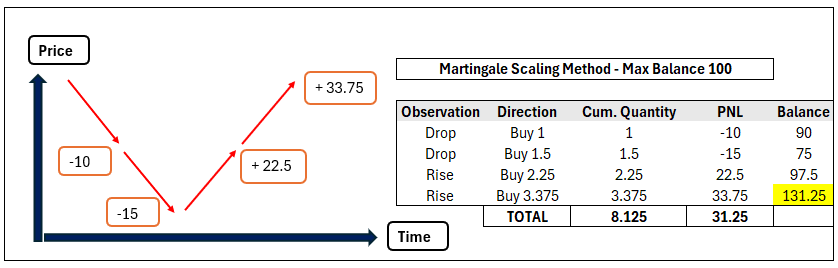
Standard Strategy Explained
1. Averaging Down on Price Drops: the strategy involves increasing the position size by purchasing additional units when the asset’s price declines.
2. Profit Target: The investor continues to buy, scaling up the position, regardless of generating profit or loss, until Position Reset takes place.
3. Position Reset: Only when the current balance is over the maximum balance recorded, CFactor, Quantity and PnL Thresholds reset to their starting levels.
This Martingale approach is conservative since the CFactor % change is 50%.
Backtesting 2024 – Martingale Standard Scaling Method
A) Deposit/Initial Equity/Investment Amount: 10,000 USD.
B) Trading Period: 10:00-22:00 Cyprus Time.
C) PnL Thresholds: 2% Upside, 2% Downside (Drawdown).
D) Variations: CFactor and PnL Threshold % Changes are Fixed
E) Asset Allocation %: Gold/XAUUSD (100% allocation).
F) Initial CFactor: 1 , CFactor Change: 50% (x1.5 multiplier), Max: 128 (max 7 Consecutive Losses).
G) Reset: Initial values (CFactor, PnL Thresholds) reset when current balance is higher than highest balance recorded.
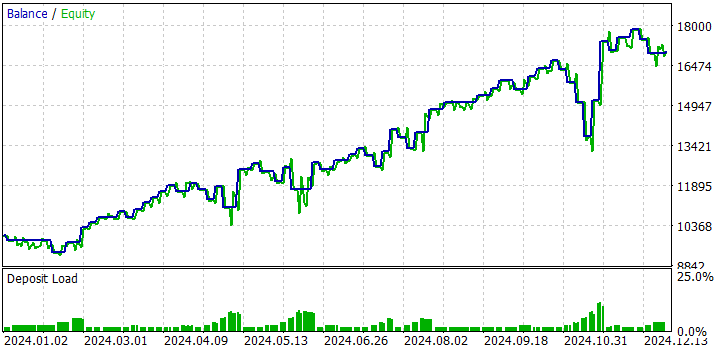
Martingale Standard Scaling Method
♦ Balance ♦ Equity
Number of Trades: 58, Consecutive Losses: 4 (-2892.30 USD)
PnL: 7,016.78 USD (70.16% ROI), Relative Equity Drawdown: 3,455.37 USD (20.69%).
Gold performed positively in 2024. Its price closed higher for the year. The strategy exploited volatility drawdowns by increasing the quantity of positions taken when prices were lower.
The 2% drawdown threshold was triggered 4 consecutive times. The relative equity drawdown remained close to 20%, near to other figures observed when testing similar martingale methods.
It successfully gained more performance with the same 2% PnL Thresholds both for upside and downside.
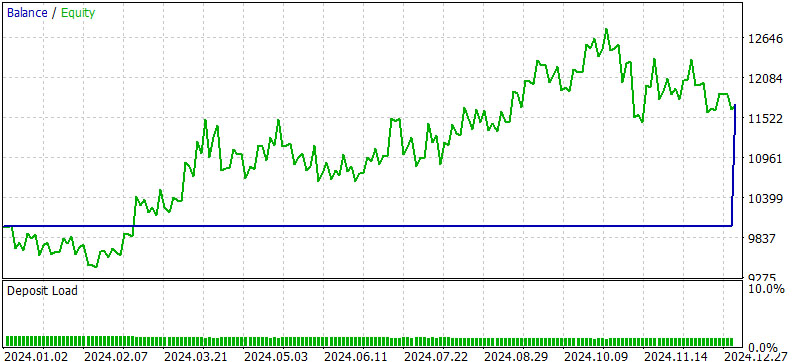
Gold Benchmark Backtest
♦ Balance ♦ Equity
Number of Trades: 1, Consecutive Losses: 0.
PnL: 1,710 USD (17% ROI), Relative Equity Drawdown: 1,310 USD (10.25%).
Since there is only one trade, the equity line reflects Gold’s price path, clearly showing that the year ended with a higher price. The price experienced a notable drawdown after October marking a drawdown figure of 10.25%.
Using the above method with 2% PnL threshold, investors should expect 4-5 consecutive losses. This allows them to estimate the loss based on this 10% drawdown expectation, taking ofcourse into account their chosen CFactor/Martingale Factor.
Performance
This method is considered successful when the asset (or portfolio of assets) has fully recovered from any drawdown experienced during the period.
Due to scaling, the performance is way higher than other methods involving martingale.
Drawdown
Investment drawdown/loss can be limited, supporting a conservative approach.
The Martingale/Cost Averaging Factor % change is 50% (not 100%) which limits the quantity bought when prices are decreasing, more than other traditional martingale methods.
Pros and Cos
Pros: Recovers loses even with CFactor change 50%, not 100%, while performance is great. It limits drawdown much relative to other methods.
Cos: It needs to have a full price reversal to cover fully losses but gains performance due to scalling.
Optimization – Martingale Standard Scaling Method
Our criteria
1) Excellent Profit Factor and Recovery 2) Low Relative Equity drawdown 3) Decent Profit with Manageable Trade Count
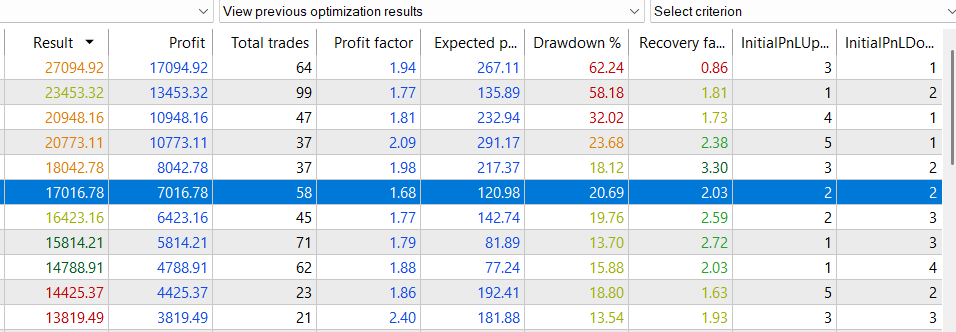
Regarding the selected Strategy (blue row)
The MT5 optimization process results, considering the Martingale Scaling method, reveal a moderately profitable trading strategy with a total profit of 7,016 USD (70.16% ROI), across 58 trades. The expected payoff of 120.98 suggests consistent performance per trade. The drawdown of 20.69% is even better than other similar methods. The picture shows the alternate strategies arising when allowing for PnL Thresholds variations.
The “Best” – Martingale Standard Scaling Strategy
♦ Balance ♦ Equity
A standout strategy—it’s the kind that quietly checks all the boxes without screaming for attention. PnL Thresholds: 3% Upside, 2% Downside Thresholds.
» Profit: 8,042 USD (80% ROI) Drawdown %: 18.12% ← Low risk
» Expected Payoff: 217.37
» Profit Factor: 1.98 ← High
» Recovery Factor: 3.30 ← Highest
» Trades: 37
Momentum Scaling – Martingale Hybrid Scaling Method
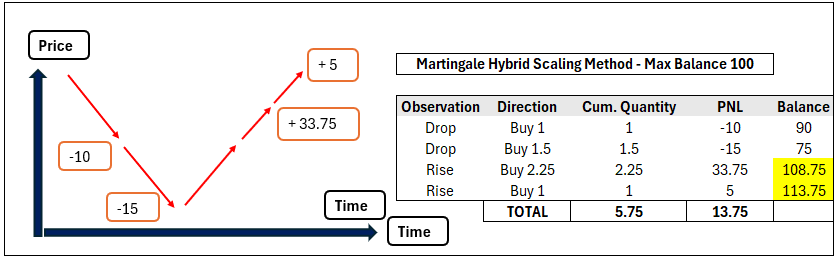
Hybrid Strategy Explained
1. Averaging Down on Price Drops: the strategy involves increasing the position size by purchasing additional units when the asset’s price declines.
2. Profit Target: The investor continues to buy, scaling up the position. The hybrid strategy allows for more upside before Position Reset takes place.
3. Position Reset: Only when the current balance is over the maximum balance recorded, CFactor, Quantity and PnL Thresholds reset to their starting levels.
This Martingale approach is conservative since the CFactor % change is 50%.
Backtesting 2024 – Martingale Hybrid Scaling Method
A) Deposit/Initial Equity/Investment Amount: 10,000 USD.
B) Trading Period: 10:00-22:00 Cyprus Time.
C) PnL Thresholds: 3% Upside, 2% Downside (Drawdown).
D) Variations: CFactor and PnL Threshold % Changes are Fixed
E) Asset Allocation %: Gold/XAUUSD (100% allocation).
F) Initial CFactor: 1 , CFactor Change: 50% (x1.5 multiplier), Max: 128 (max 7 Consecutive Losses).
G) Reset: Initial values (CFactor, PnL Thresholds) reset when current balance is higher than highest balance recorded.
Martingale Hybrid Scaling Method
♦ Balance ♦ Equity
The “Best” – Martingale Scaling Strategy
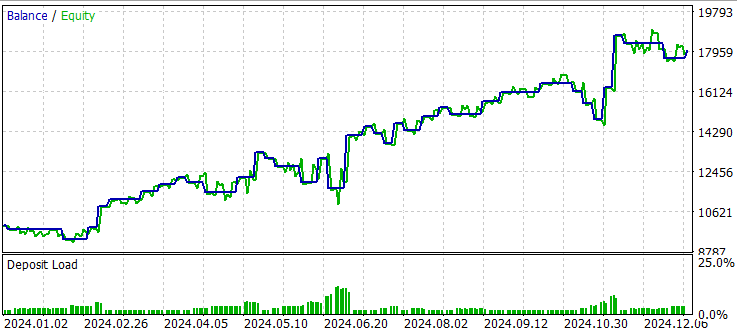
Trades: 37, Consecutive Losses: 3 (-1,649 USD)
PnL: 8,042 USD (80.42% ROI), Relative Equity Drawdown: 2,436.87 USD (18.12%).
The strategy was able to exploit drawdowns by increasing its position when prices were lower. The 2% drawdown threshold was triggered three consecutive times, resulting in a total loss of $1,649. This is the optimal strategy mentioned in the previous section, the result of the optimization process that involved exploring different variations of PnL Thresholds. Importantly, the upside was set at 3% instead of 2%.
Performance
Successful to reach higher performance than the standard method.
Due to scaling, the performance is way higher than other methods involving martingale.
Drawdown
Investment drawdown/loss was reported lower than the standard method, below 20%.
The Cost Averaging Factor % change is 50% (not 100%) limiting drawdown significantly.
Pros and Cos
Pros: Profit Factor, Expected Payoff and Recovery Factor are higher than the standard method. It limits drawdown much relative to other methods.
Cos: Lower number of trades. More time needed to close/reset positions than the standard method.
Optimization – Martingale Hybrid Scaling Method
Our criteria
1) Moderate Profit Factor and Recovery 2) Low Relative Equity drawdown 3) Excellent Profit with Manageable Trade Count
Regarding the selected Strategy (blue row)
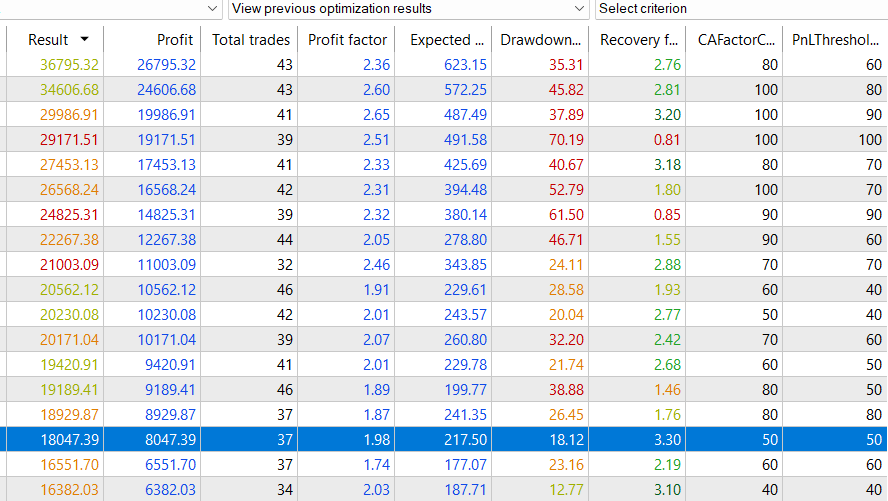
The MT5 optimization process results, considering the Martingale Hybrid Scaling method, reveal a profitable trading strategy with a total profit of 8,042 USD (80.42% ROI), across just 37 trades. This is the result with fixed CFactor and PnL Threshold % Changes at 50%.
The expected payoff of 217 suggests consistent and higher performance per trade than the standard method. The drawdown of 18.12% is even better than other similar methods and is lower than the standard method.
The picture shows the alternate strategies arising when allowing for CFactor and PnL Thresholds % Changes variations.
The “Best” – Martingale Hybrid Scaling Strategy
♦ Balance ♦ Equity
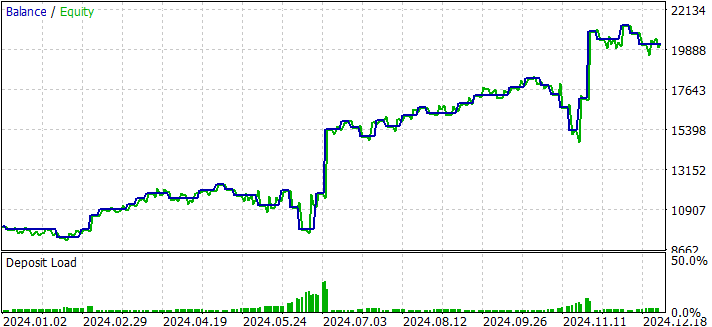
PnL Threshold were kept fixed at 3% Upside and 2% Downside, allowing for variations on % Changes of CFactor and PnL Thresholds. Optimization strategy: This strategy involves, CFactor % Change: 50% ,PnL Thresholds % Change: 40%. Chosen because of a smooth, less volatile path.
» Profit: 10,230.08 USD (102.31% ROI) Drawdown %: 21.81% ← Low risk
» Expected Payoff: 243.57
» Profit Factor: 2.01 ← Over 2 is good
» Recovery Factor: 2.77
» Trades: 42
Momentum Scaling – Martingale Aggressive Scaling Method
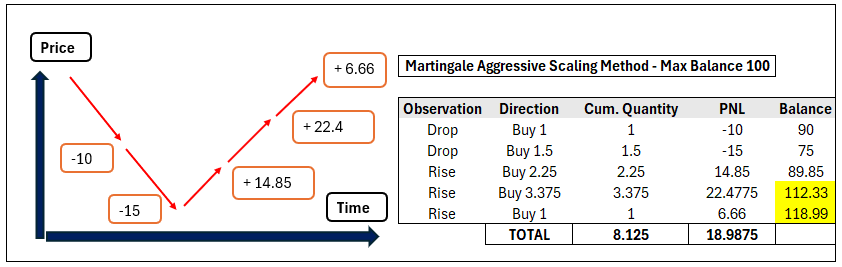
Aggressive Strategy Explained
An alternative to the above with the only difference that it allows for faster scaling. We know have lower PnL Upside than PnL Downside Threshold.
1. This is building up quantity faster as the price reverses.
2. It allows for more performance and faster reset to initial CFactor and PnL Thresholds.
3. Optimization results show lower drawdowns when using this method.
Backtesting 2024 – Martingale Aggressive Scaling Method
A) Deposit/Initial Equity/Investment Amount: 10,000 USD.
B) Trading Period: 10:00-22:00 Cyprus Time.
C) PnL Thresholds: 2% Upside, 3% Downside (Drawdown).
D) Variations: CFactor and PnL Threshold % Changes are fixed.
E) Asset Allocation %: Gold/XAUUSD (100% allocation).
F) Initial CFactor: 1 , CFactor Change: 50% (x1.5 multiplier), Max: 128 (max 7 Consecutive Losses).
G) Reset: Initial values (CFactor, PnL Thresholds) reset when current balance is higher than highest balance recorded.
Martingale Aggressive Scaling Method
♦ Balance ♦ Equity
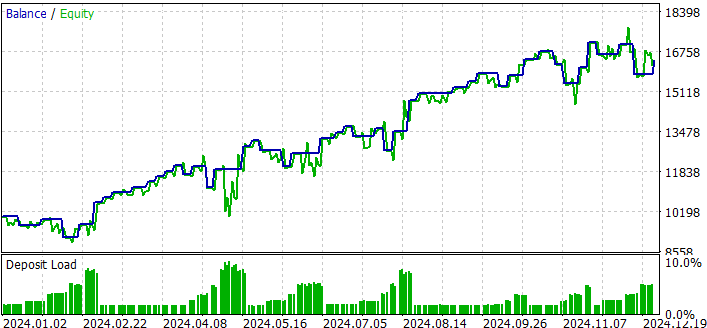
Trades: 45, Consecutive Losses: 2 (-1,301 USD)
PnL: 6,429 USD (64.29% ROI), Relative Equity Drawdown: 2,480.42 USD (19.76%).
The strategy was able to exploit drawdowns by increasing its position when prices were lower but closes positions quickly due to lower upside threshold. The 3% drawdown threshold was triggered 2 consecutive times, resulting in a total loss of $1,301.
This is NOT the optimal strategy when having the PnL Upside Threshold set at 2% while the PnL Downside Threshold is 3%. In the next section we will allow for variations in CFactor and PnL Threshold % Changes.
Performance
Lower performance than the hybrid method.
Quick scaling results in performance lower than other scaling methods.
Drawdown
Investment drawdown/loss was reported near 20%. Not much improvement.
The Cost Averaging Factor % change is 50% (not 100%) limiting drawdown significantly.
Pros and Cos
Pros: Profit Factor, Expected Payoff and Recovery Factor are lower than the hybrid method.
Cos: While drawdown remains to similar levels as the hybrid approach, the profitability is lower.
Optimization – Martingale Aggressive Scaling Method
Our criteria
1) Excellent Profit Factor and Recovery 2) Low Relative Equity drawdown 3) Priority is Profit with Manageable Trade Count
Regarding the selected Strategy (blue row)
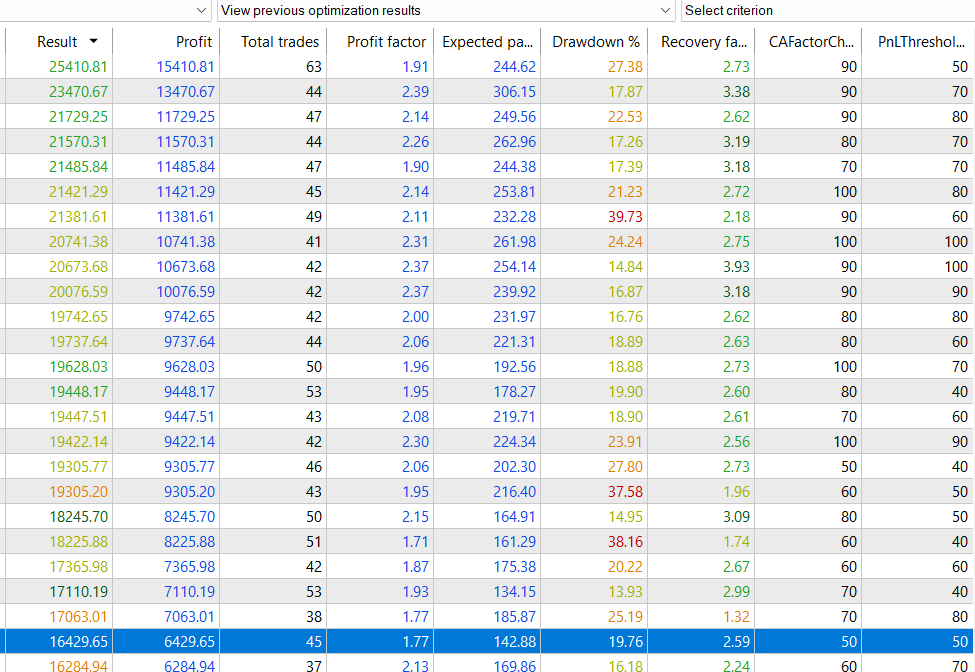
The MT5 optimization process results, considering the Martingale Aggressive Scaling method, reveal a profitable trading strategy with a total profit of 6,429 USD (64.29% ROI), across 45 trades.
This is the result with fixed CFactor and PnL Threshold % Changes at 50% and it is the strategy described in the previous section.
The expected payoff of 142.88 suggests consistent performance per trade but is lower than the hybrid method. The drawdown of 19.76% is near to figures observed in other similar methods.
The picture shows the alternate strategies arising when allowing for CFactor and PnL Thresholds % Changes variations.
The “Best” – Martingale Aggressive Scaling Strategy
♦ Balance ♦ Equity
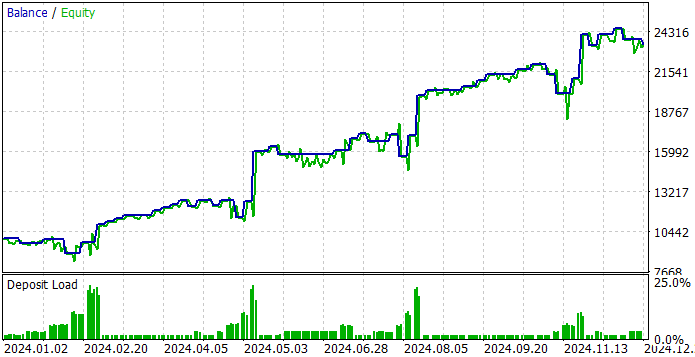
PnL Threshold were kept fixed at 2% Upside and 3% Downside, allowing for variations on % Changes of CFactor and PnL Thresholds. Optimization strategy: This strategy involves, CFactor % Change: 90% ,PnL Thresholds % Change: 70%. Chosen because it has high performance and lower drawdown making it ideal.
» Profit: 13,470 USD (134.7% ROI) Drawdown %: 17.87% ← Low risk
» Expected Payoff: 306.15 ← Quite high
» Profit Factor: 2.39 ← Over 2 is good
» Recovery Factor: 3.38 ← Over 3 is good
» Trades: 44
Momentum Scaling – Summary
With Momentum Scaling methods the general idea involves buying more quantity when prices are lower, keeping a conservative approach, while scaling up after price reversals. Depending on the type of scaling strategy, from the ones described above, there will be a trade-off between drawdown and profitability. By using optimization, allowing for not only variations between the CFactor and PnL Thresholds but for variations of their % changes as well, the “best” strategies were identified. Importantly, the Performance ROIs are way higher for these strategies than the traditional cost averaging strategies and at the same time they show lower or the near the same level of risk, indicating that they are superior to the traditional cost averaging methodology.
Marios C.Kyriakou (Author / Researcher)
Trading instructor, Technical Analyst, MQL Programmer and experienced Portfolio Manager, Marios C.Kyriakou has been working in the financial services industry for more than 10 years. Marios is dedicated to understanding the intricacies of the markets, refining his own personal strategies, and educating those interested in delving deeper into the world trading and investing online.