

High Risk – High Reward
A growth strategy that aims to generate high return from short-term price flactuations. Investors following this approach have high exposure to risk that is related to short-term unexpected market conditions. It is suitable for investors who seek high short-term returns but are willing to accept that huge intraday losses are part of the strategy’s process to achieve growth.
Investment Considerations
This strategy emphasizes is pursuing opportunities for growth on an intraday basis. The methodology involves following the market direction, not going against it. A With The Market approach involves entering into a position after the market moved to a particular direction. The position’s direction matches the market’s direction.
Particularly, the algorithm involves cheking the price’s daily performance and enter’s the position accordingly. If there is a jump the the position is long. If there is a dive, then the position is short. A market crash would result in profit. A market soar woould result again in profit. Only in the case in which there is a sideways price action, losses are generated.
Volatile prices/assets are usually prefered, however, spreads are usually high causing the strategy to face challenges. For this reason we prefer to choose highly liquid assets that would not cause big problems. Despite this, there are efforts taking place to increase the probability of reducing the number of consecutive losses.
Investment Strategy
We aim to maximize returns by taking on higher risks. The nature of the strategy involves daily consecutive losses arising from a sideways price movement.
♦ A Single Asset: In the case of a single asset we are looking at price volatility and choose appropriate TP and SL that will allow us to have at least 1 profitable trade per day.
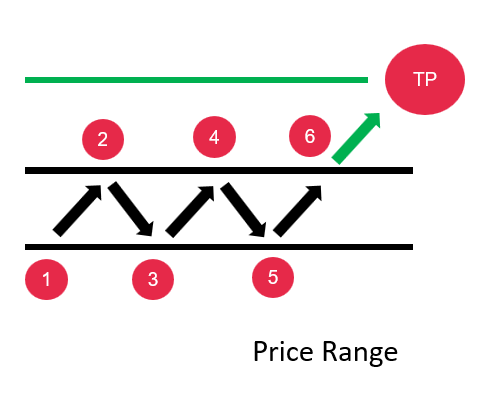
A simple example with 7 consecutive losses and CFactor Change 100% would give the below results:
1) SELL trade
2) SL is hit (-50), BUY Trade
3) SL is hit (-100), SELL Trade
4) SL is hit (-200), BUY Trade
5) SL is hit (-400), SELL trade
6) SL is hit (-800), BUY trade
7) TP is hit (+1600): 1600-1550 = 50 USD Profit.
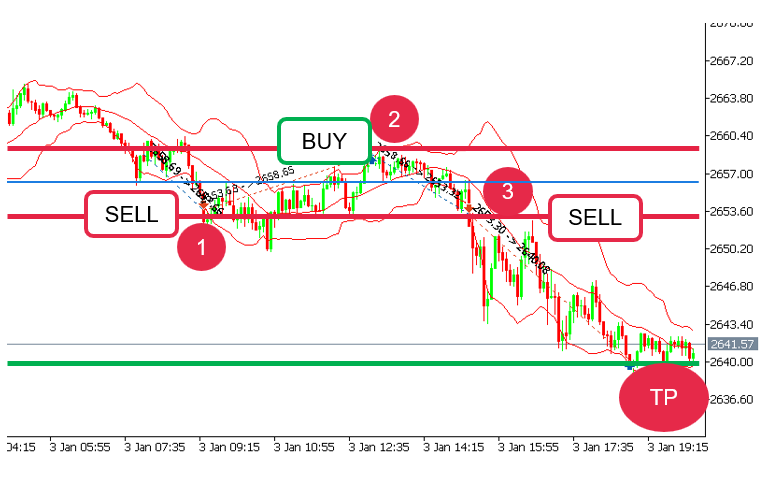
An empirical example is on the picture on the right where it depicts 2 consecutive losses. The 3rd trade is hit with TP.
Since during the day, the price cannot always remain inside a price range, inevitably it will deviate from that range at some point reaching the TP.
Variations affecting Risk and Performance
In this section, we aim to select the appropriate TP and SL thresholds that will allow us to implement the strategy. With the EA implemented, we are not choosing lot sizes or specific quantities to buy /sell. We choose to close the positions when the equity is increasing or decreasing by a specific % amount/threshold. The equity decrease or increase amoutn depends obviously from the quantity chosen to trade. This is determined by the equity allocation % parameter assigned to that asset.
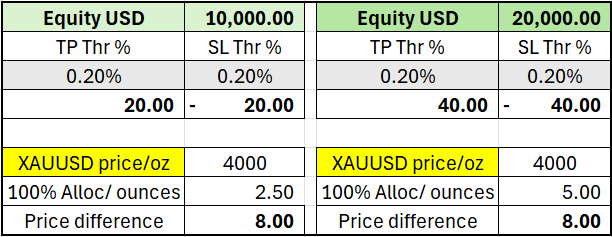
♦ Example: Equity Amount: 10,000 USD. % allocation to investing 100%.
-
InitialPnLUpsideThreshold = 0.2. Profit Taking Threshold (% of equity)
InitialPnLDownsideThreshold = 0.2. Stop Loss Threshold (% of equity)
This means that if equity increases by 0.2% then the EA closes positions (TP). Vice versa for SL. With Equity increase, the price difference does not change, the PnL increases. This means that the chosen volatility/price deviations TP and SL are not affected by equity variations (i.e. increase due to Profit).
♦ Example: Equity Amount: 10,000 USD. % allocation to investing 50%.
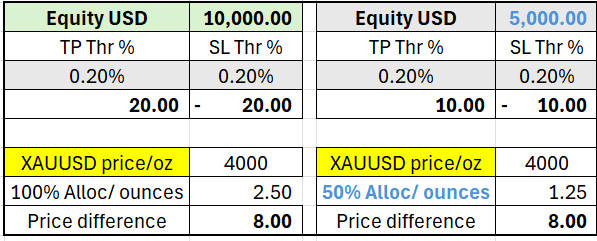
The user is choosing to allocate less equity, investment is limited to 50% of the equity in this example, so 5000 instead of 10000. The quantity traded now is less, ounces are lower, the price difference chosen is not affected by the lower investment amount but the quantity traded lowered and so the PnL. The investor is choosing to allocate less amount for investing and it is only logical that should earn less from the same price movement.
♦ Example: Equity Amount: 10,000 USD. % allocation to investing 50%.
The user is choosing to allocate less equity, investment is limited to 50% of the equity in this example, so 5000 instead of 10000. The quantity traded now is less, ounces are lower, the price difference chosen is not affected by the lower investment amount but the quantity traded lowered and so the PnL. The investor is choosing to allocate less amount for investing and it is only logical that should earn less from the same price movement.
♦ Example: Equity Amount: 10,000 USD. % allocation to investing 100%. Keeping Investment Fixed to 10,000.
The user is is epxeriencing equity increase while profit is accumulated. Due to the fact that allocation % remains the same, the investment amount increases. The EA increases the quantity bought/sold, thus increasing risk. We can keep the investment amount fixed and so the quantity traded will be the same regardless of amount of equity. Due to changes in the price of the asset the quantity bought/sold will be affected by price changes but at least it will not be affected by PnL.
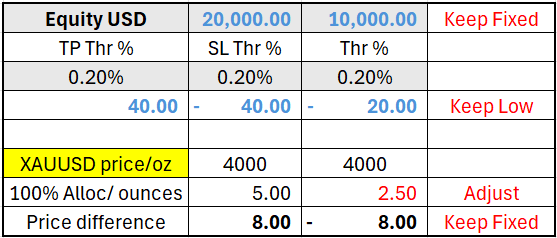
The Consecutive Losses Range, TP and SL
Based on the above, if we exclude the fact that a price increase will affect the price difference amount by increasing it (considering that the effect will not be great), we will have the below setup and run backtesting.
What are the criteria for choosing the correct TP and SL Thresholds? We need to take into consideration the intraday volatility of the asset.
♦ XAUUSD Example: Days with no activity show in 2025 that Gold is moving sideways in a range of 10 USD. This means that SL + TP deviation in USD amounts should be near 10 USD.
-
Trading Period: 2:00 – 23:00 (market opens at 1:00).
-
Starting Price 2025: Aprox 2600 USD/oz.
-
Equity Amount: 10,000 USD. % allocation to investing 100%.
-
Investment Fixed: 10,000 USD.
-
Losing Trades per Day: No Limit Profitable Trades per Day: 1.
-
Close All positions when Trading Period ends? NO
♦ Setup Parameters:
-
InitialPnLUpsideThreshold = 0.2. Profit Taking Threshold (% of equity). The TP Price Difference Amount is approx 5 USD.
-
InitialPnLDownsideThreshold = 0.2. Stop Loss Threshold (% of equity). The SL Price Difference Amount is approx 5 USD.\
-
CFactor Change: 100%. PnL Thresholds Change: 100%.
Results:
-
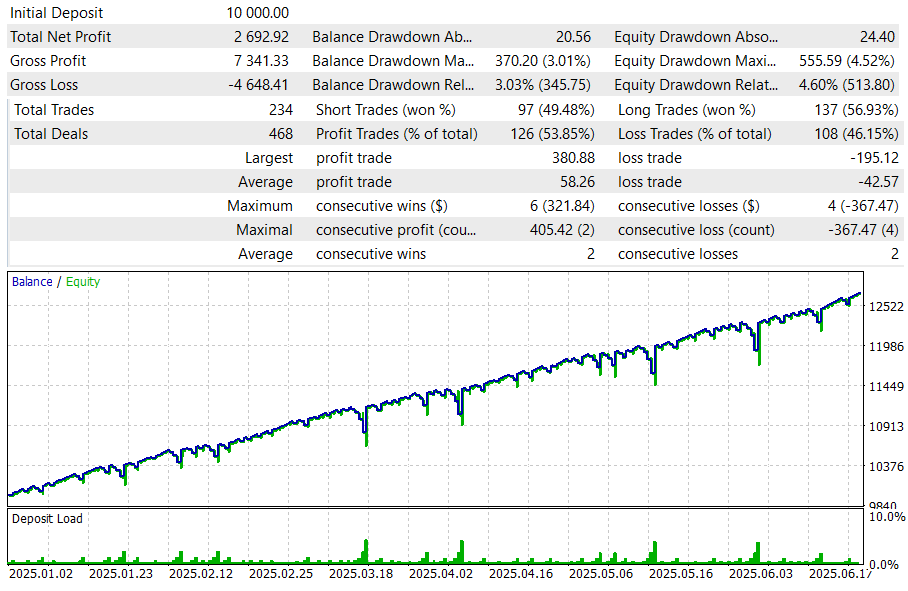
ROI: We have 26.92 %. Risk: 4 consecutive losses (-367.47 USD).
-
Profit Trades: 53.85% vs Loss Trades: 46.15%.
The CFactor Change 100% is considered extremely risky since after a small number of consecutive losses the account balance can be wiped out easily. Profit Trades % vs Loss trades % which is roughly 50% proves in 234 trades that there is roughly equal probability of having a profitable versus a losing trade.
Backtesting 1st-6th 2025
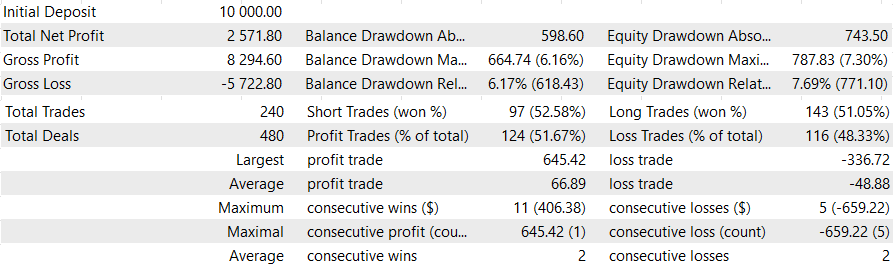
♦ Setup Parameters: Similar setup as above.
InitialPnLUpsideThreshold = 0.2. Profit Taking Threshold (% of equity). The TP Price Difference Amount is approx 6.6 USD.
InitialPnLDownsideThreshold = 0.2. Stop Loss Threshold (% of equity). The SL Price Difference Amount is approx 6.6 USD.
Note: The price of XAUUSD increased greatly to 3300 USD. Due to the asset’s price increase through time, the price difference allowed for TP and SL changed. Despite that the rest of the 6 months show roughly the same results.
Backtesting 7th-12th 2025
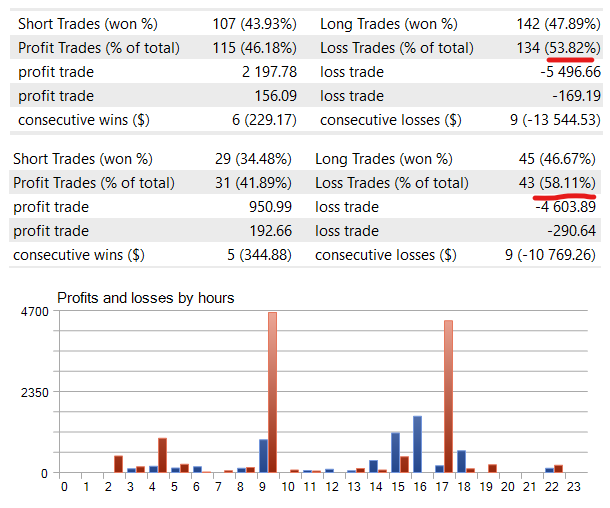
Probabilities Check: In the case when the price deviates significantly from the day’s small range, it might experience a big deviation. By increasing the TP, the probabilities (profitable vs losing trades %) changes dramatically. We would expect it to change more towards the losing trades.
♦ XAUUSD Example: 9 consecutive losses and indeed the losses were more. so this failed.
1) TP increased a little. TP=0.3 SL=0.2
This resulted in consecutive losses to increase. More losing positions were observed during the afternoon when news and announcements are taking place (15:00-17:00 Cy Time).
2) TP increased much. TP=0.5 SL=0.2
This resulted in consecutive losses to increase as well. Losing trades were observed now also during the morning hours (8:00-10:00 Cy Time). Logical since the TP was difficult to get hit during active sessions.
The goal is to improve by reducing the consecutive losses. We do not want to reduce the TP to achieve that, but we have to find a way to increase the number of profitable trades when TP is at least equal to SL.
Backtesting 1st-6th 2025
In this setup it is important to identify the correct time (and date) to enter the market. The ideal “correct” time is the one that, as soon as there is entry there is a TP hit. Due to entering at a wrong time, there are consecutive losses before a TP takes place. How to improve our probabilities for a correct entry?
1) Time: Usually, during illiquid hours, the market is moving sideways. Entering the market during illiquid hours (non active sessions) decreases the probability of entering at the correct time. Enter when more activity is expected. This increases the probability of the market moving one side with high deviation. Choosing the correct trading period matters.
2) Volatility: We do not want to the price to move up and down too much quickly. This happens usually during scheduled releases. This will cause consecutive losses. This is related to choosing the correct trading period.
3) Dependency: There are days when the price is moving to one direction without any significant news release to take place. There are other days when the price is moving sideways and waits until a scheduled release is pushing it to one direction heavily.
1) Trading Period: 3:00 – 10:00 Cy Time. Enter at 3:00 (not at market opening 1:00 Cy time) when prices are more stable. During this illiquid session we do not expect to have many consecutive losses.
2) Close Positions at the End of Trading Period: To avoid the volatility issue (ups and downs) we need a Stop rule. Consecutive losses per day limit.
3) TP= 1 .00 SL= 0.2. This allows to test how many consecutive losses we can have if the TP is very high with this setup.
Backtesting 2024-2025
