

A structured approach to Investment Strategy
(1) Define Financial Goals (2) Assess Risk Tolerance
(3) Determine Time Horizon (4) Select Investment Style
(5) Asset Allocation & Diversification (6) Continuous Monitoring & Rebalancing
TI Based Approach
TI stands for Traditional Investment. Asset positions are consistently held in a long/buy direction. The methods below are based on the simplest form of the cost-averaging approach that involves buying more quantity when prices are low and sell when prices are high.
Cost Averaging – Traditional Martingale Method
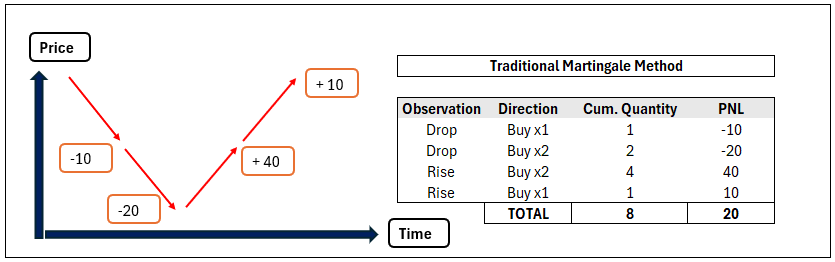
Strategy Explained
1. Averaging Down on Price Drops: it involves purchasing additional units when the asset’s price declines. However, each price drop results in a temporary loss due to the portfolio’s declining value.
2. Profit Target: Using martingale methodology and CFactor 100%, the profit from the final upward move is designed to offset all previous losses—assuming no transaction costs, swaps, or other fees.
3. Position Reset: Once the market rebounds and the position reaches a profit, the investor resets to the original quantity.
All 4 units during the drop were purchased at successively lower prices.
Backtesting 2024 – Traditional Martingale Method
A) Deposit/Initial Equity/Investment Amount: 10,000 USD.
B) Trading Period:10:00-22:00 Cyprus Time.
C) PnL Thresholds: 2% Upside, 2% Downside (Drawdown).
D) Variations: CFactor and PnL Threshold % Changes are Fixed
E) Asset Allocation %: Gold/XAUUSD (100% allocation).
F) Initial CFactor: 1 , CFactor Change: 100% (x2 multiplier), Max: 128 (max 7 Consecutive Losses).
G) Reset: Initial values (CFactor, PnL Thresholds) reset when positions close with profit.
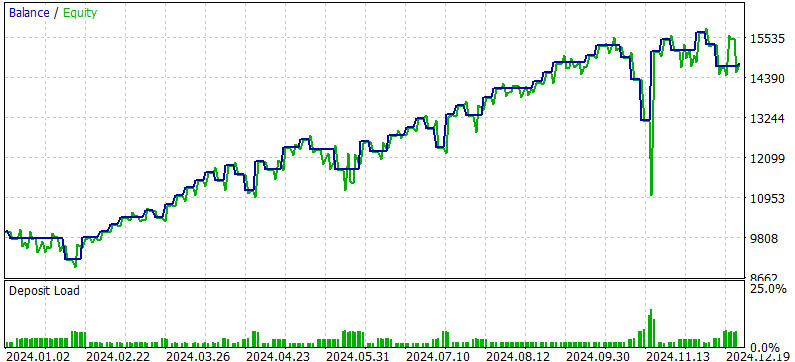
Traditional Martingale Method
♦ Balance ♦ Equity
Trades: 50, Consecutive Losses: 3 (-2154 USD)
PnL: 4,813 USD (48.13% ROI), Relative Equity Drawdown: 4,853.7 USD (29.04%).
Gold performed positively in 2024. Its price closed higher for the year. The strategy exploited volatility drawdowns by increasing the quantity of positions taken when prices were lower.
The 2% drawdown threshold was triggered 3 consecutive times indicating a cumulative price decline of over 6%. The relative equity drawdown was 29%, which is considered high.
It successfully had good performance with a 48.13% ROI and with the same 2% PnL Thresholds both for upside and downside.
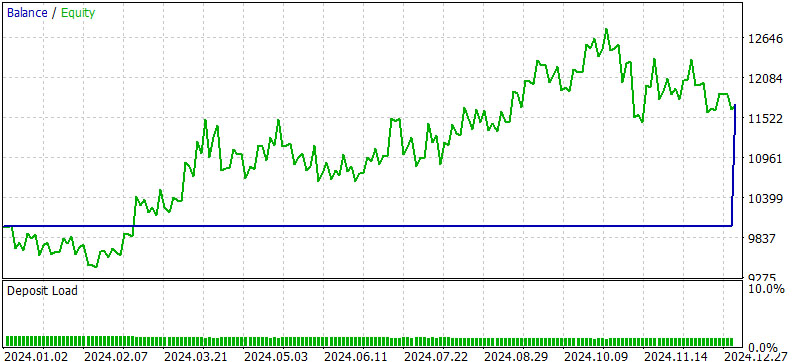
Gold Benchmark Backtest
♦ Balance ♦ Equity
Trades: 1, Consecutive Losses: 0.
PnL: 1,710 USD (17% ROI), Relative Equity Drawdown: 1,310 USD (10.25%).
Since there is only one trade, the equity line reflects Gold’s price path, clearly showing that the year ended with a higher price. The price experienced a notable drawdown after October marking a drawdown figure of 10.25%.
Using the above method with 2% PnL threshold, investors should expect 4-5 consecutive losses. This allows them to estimate the loss based on this 10% drawdown expectation, taking ofcourse into account their chosen CFactor/Martingale Factor.
Performance
This method is considered successful when the closing price at the end of the investment period is equal to or higher than the opening price. It succeeds when the asset has fully recovered from drawdowns as long as the are enough funds to support them.
Drawdown
Investment drawdown/loss depends on the price drawdown during the investment period. The Cost Averaging Factor determines how much more quantity will be bought when prices are decreasing. The higher this factor is, the higher the drawdown.
Pros and Cos
Pros: Recovers loses without a full price reversal, if CFactor 100%. It limits exposure by lowering the quantity bought relatively quickly.
Cos: It carries great risk when prices dive, especially with CFactor 100%. Failing to estimate potential loss can be devastating.
Optimization – Traditional Martingale Method
Our criteria
1) Moderate Profit Factor and Recovery 2) Low Relative Equity drawdown 3) Satisfying Profit with Manageable Trade Count
Regarding the selected Strategy (blue row):
The MT5 optimization process results, considering the Standard Martingale Method, reveal a fairly profitable trading strategy with a total profit of 4,813 USD (48.13% ROI), across 50 trades.
The expected payoff of 96.27 suggests fair performance per trade. The drawdown of 29.04% is actually not low enough. The picture shows the alternate strategies arising when allowing for PnL Thresholds variations.
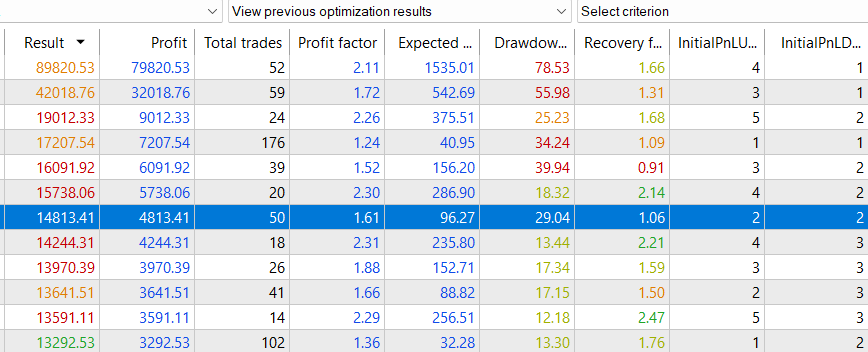
The “Best” – Traditional Martingale Strategy
♦ Balance ♦ Equity
A strong middle ground between profit and risk is the one with:
PnL Thresholds: 4% Upside, 2% Downside Thresholds.
» Profit: 5738 USD (57% ROI) Drawdown %: 18.32% ← Low risk
» Expected Payoff: 286.9
» Profit Factor: 2.30 ← Highest in table
» Recovery Factor: 2.14
» Trades: 20
Cost Averaging – Martingale Hybrid Investing Method
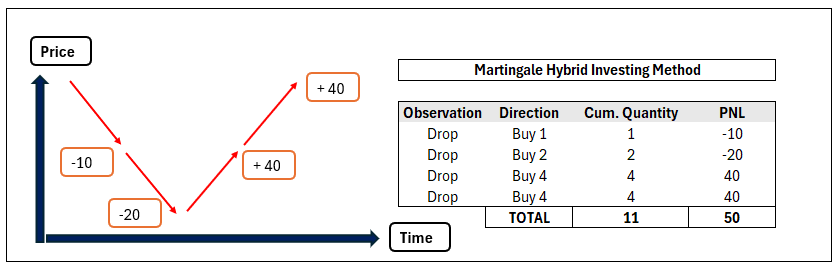
Strategy Explained
1. Averaging Down on Price Drops: it involves purchasing additional units when the asset’s price declines. However, each price drop results in a temporary loss due to the portfolio’s declining value.
All 4 units during the drop were purchased at successively lower prices.
2. Profit Target: Using a CFactor change 100%, the quantity bought remains the same until the price reverses fully from the price drop, resulting in higher profit than the traditional method.
3. Position Reset: Once the market rebounds and the position reaches a profit, the investor DOES NOT reset to the original quantity immediately. Only after a full price reversal.
Performance
This method is considered successful when the closing price at the end of the investment period is equal to or higher than the opening price. It succeeds in higher performance than the Traditional Martingale Strategy due to the fact that it does not reset the quantity bought too quickly.
Drawdown
Investment drawdown/loss depends on the price drawdown during the investment period. The Martingale/Cost Averaging Factor determines how much more quantity will be bought when prices are decreasing. Drawdown can turn significantly high if the price drops rapidly after large quantity was bought.
Pros and Cos
Pros: Recovers loses without a full price reversal with CFactor change 100%. It allows room for the price to reverse fully before it resets to buying lower quantity resulting in higher profits.
Cos: It carries even greater risk when prices dive, greater than the Traditional Martingale Method.
Backtesting 2024 – Martingale Hybrid Investing Method
A) Deposit/Initial Equity/Investment Amount: 10,000 USD.
B) Trading Period:10:00-22:00 Cyprus Time.
C) PnL Thresholds: 4% Upside, 2% Downside (Drawdown).
D) Variations: CFactor and PnL Threshold % Changes are Fixed
E) Asset Allocation %: Gold/XAUUSD (100% allocation).
F) Initial CFactor: 1 , CFactor Change: 100% (x2 multiplier), Max: 128 (max 7 Consecutive Losses).
G) Reset: Initial values (CFactor, PnL Thresholds) reset when positions close with profit and when hitting the 4% threshold which is x 2% the downside threshold, a full pice reversal.
Martingale Hybrid Investing Method
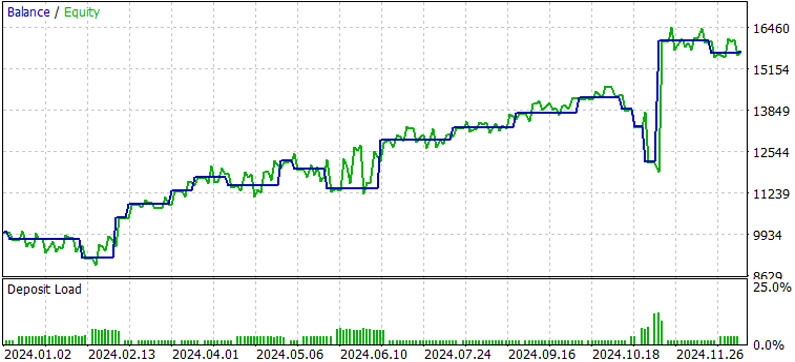
♦ Balance ♦ Equity
Trades: 20, Consecutive Losses: 3 (-2018 USD)
PnL: 5,738 USD (57.38% ROI), Relative Equity Drawdown: 2,680.14 USD (18.32%).
Gold’s price closed higher for the year so the strategy was successful. It exploited volatility drawdowns by increasing the quantity of positions taken when prices were lower.
The 2% drawdown threshold was triggered 3 consecutive times accumulating a loss of 2K. The relative equity drawdown resulted 18%, which is considered high.
It successfully had higher performance from the standard method, with a 57.38% ROI, having higher PnL Upside Threshold (double the downside threshold).
Regarding the selected Strategy (blue row):
The MT5 optimization process results, considering the Hybrid Martingale Method, reveal a fairly profitable trading strategy with a total profit of 5,738 USD (57.38% ROI), higher than th traditional method.
The expected payoff of 286.90 suggests consistent performance per trade. The drawdown of 18.32% is low enough. The picture shows the alternate strategies arising when allowing for PnL Thresholds variations.
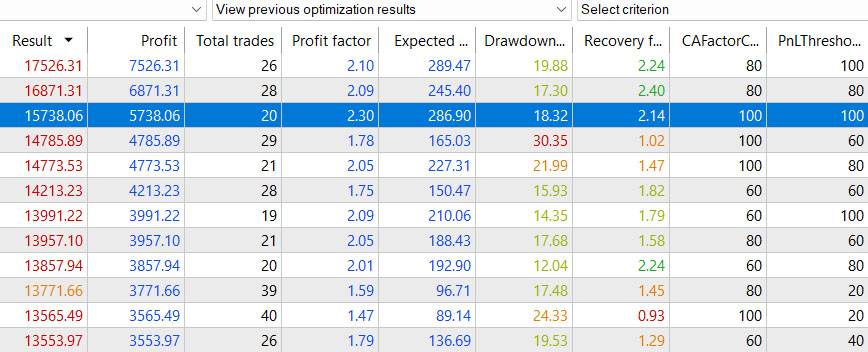
The “Best” – Martingale Hybrid Investing Strategy
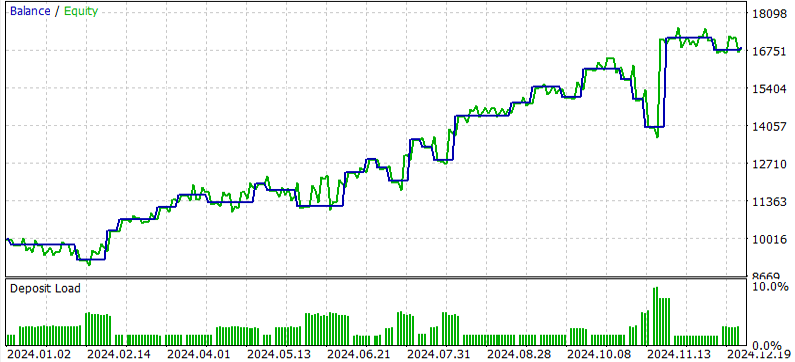
♦ Balance ♦ Equity
PnL Threshold were kept fixed at 4% Upside and 2% Downside, with variations on % Changes of CFactor and PnL Thresholds. Optimization strategy with lower drawdown and higher ROI below. Strategy involves PnL Thresholds % Change: 80%, CFactor % Change: 80%.
» Profit: 6871.31 USD (68.71% ROI)
» Expected Payoff: 245.4
» Drawdown %: 17.30% ← Low risk
» Profit Factor: 2.09 ← Over 2 is good
» Recovery Factor: 2.40
» Trades: 28
Cost Averaging – Summary
With Cost Averaging methods, the general idea involves buying more quantity when prices are lower. Depending on the type of martingale strategy, from the ones described above, there will be a trade-off between drawdown and profitability. By using optimization, allowing for not only variations between the CFactor and PnL Thresholds but for variations of their % changes as well, the “best” strategies were identified. Some involve moderate risk while the others are more conservative. Having a conservative approach to risk means to aim for as much low drawdown as possible, keeping however the balance between risk and reward.
Cost Averaging Factor (CFactor) % Change: This parameter controls how aggressive buying will be when prices are falling. Investment amount is actually increasing according to the CFactor % Change parameter. As this parameter gets lower and away from the 100% figure, the risk of massive loss becomes lower and lower.
PnL Thresholds (Upside and Downside) % Change: This controls when the next rebalancing (closing and opening of new positions) takes place. It also acts as TP and SL for the overall portfolio value. For example, when the Undrealized PnL causes the equity to decrease by the PnL Downside Threshold, a Position closing and Reset (rebalancing) takes place, with new increased investment amount (new quantities) according to the CFactor % Change parameter.
Max Loss Estimation: This can be estimated according to expectations. By looking at the maximum equity drawdown from backtesting, relevant to the specific assets and strategy, we can calculate and estimate the maximum loss. For example, if the max equity drawdown of the assets prices is 10%, the PnL Downside Threshold Figure is 3%, it is expected that the strategy will have at least 3 consecutive losses. Taking into account the CFactor % Change 100% and a SL of 30 USD (3% of 1000 initial inevstment), then around 210 USD ( 1st loss 30, 2nd loss 60, 3rd loss 120) will be the maximum loss (not including swap/commission charge which affects equity).
Marios C.Kyriakou (Author / Researcher)
Trading instructor, Technical Analyst, MQL Programmer and experienced Portfolio Manager, Marios C.Kyriakou has been working in the financial services industry for more than 10 years. Marios is dedicated to understanding the intricacies of the markets, refining his own personal strategies, and educating those interested in delving deeper into the world trading and investing online.